
The Brand Growth Guide · Part 03
From Brand Values to Retail Success
Learn how sexual wellness brands can translate purpose, positioning and values into a retail proposition that buyers understand and customers choose.
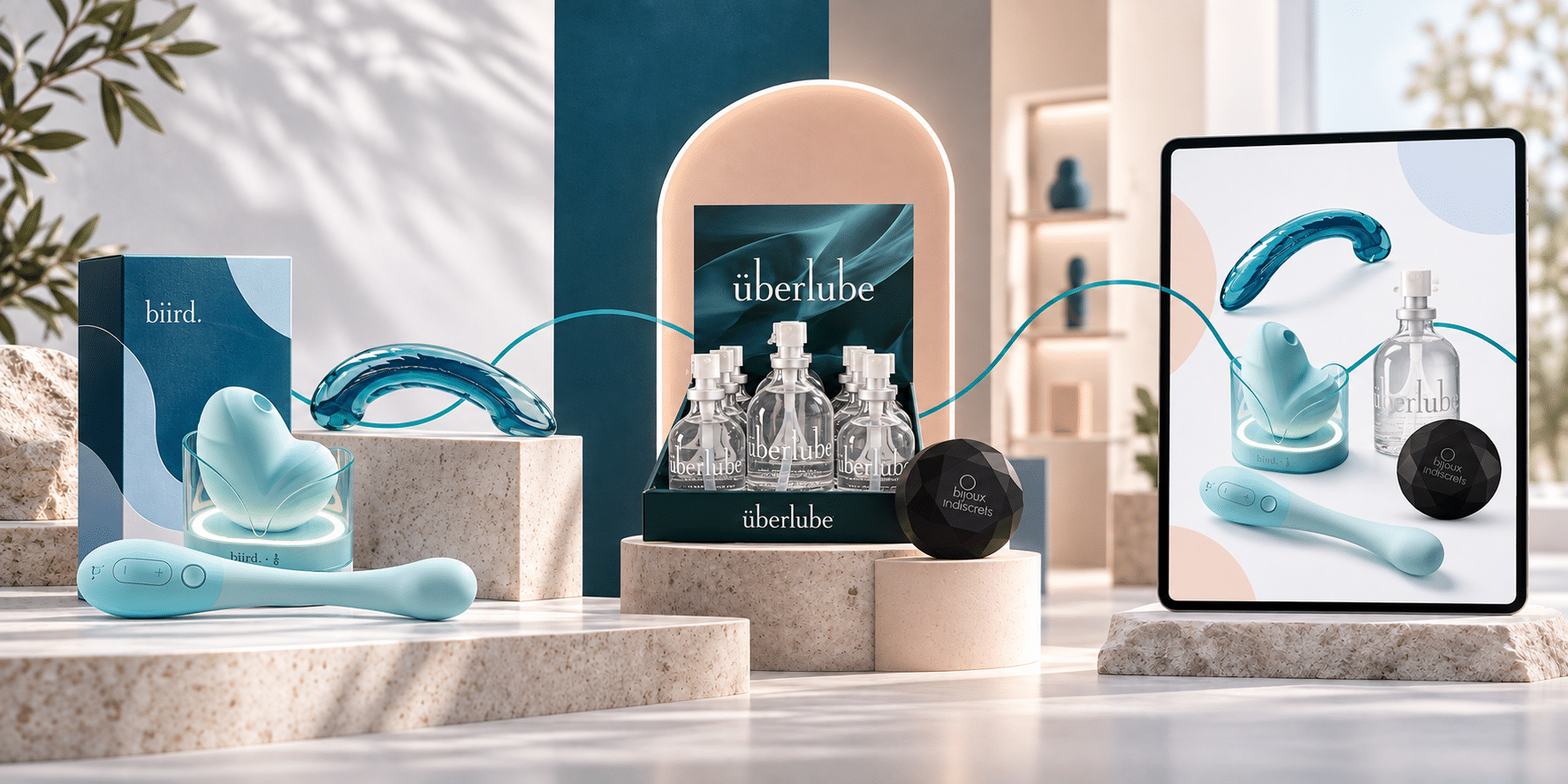
A brand can be beautifully defined in a strategy deck and still disappear at the point of sale.
Retail compresses the story. A buyer may give it ten minutes, a member of staff thirty seconds and a customer only a glance at a box or product page. The growth challenge is not to repeat the brand purpose more loudly. It is to preserve its meaning through each commercial handover—from founder to buyer, buyer to staff, and staff or screen to customer.
Define the Non-Negotiable Brand Codes
Before adapting the brand for different retailers, decide what cannot change. These codes may include a core customer promise, a tone of voice, a visual principle, the evidence standard behind claims and the behaviours expected from partners.
Keep the list short. If everything is described as essential, retail teams cannot distinguish the signal from the decoration.
Build a Message Hierarchy
The complete founder story is rarely the right story for the shelf. Create three levels of communication:
- A six-second message that makes the product relevant at a glance.
- A thirty-second explanation a sales associate can remember and repeat.
- A deeper digital story for customers who want evidence, comparison and detail.
Each level should express the same idea with a different degree of depth. Compression should remove detail, not change meaning.
Create a Proof Architecture
For every important brand value, complete four fields: what we believe; what the product proves; why that matters to the customer; and how retail makes it visible.
“Inclusive” is not retail evidence. An intuitive control, considered sizing, representative imagery and plain-language guidance are evidence. “Premium” is not evidence either; materials, finish, service and warranty may be.
The framework prevents values from remaining abstract and gives buyers something they can merchandise, explain and defend.
Translate by Channel Without Changing Identity
Different retail environments require different emphasis. Pharmacy may lead with reassurance, evidence and care. A concept store may foreground design and cultural relevance. A specialist can support greater technical depth. Ecommerce needs comparison language, search clarity and answers to objections.
Adapt the route into the story, not the story itself.
Design for the Decision Point
Audit every place where a customer or retail partner must make a decision: the packaging front, buyer deck, shelf card, product page, comparison guide, staff prompt and FAQ.
Each touchpoint should answer the question appropriate to that moment. A pack should not carry the entire brand manifesto; it should help the customer understand relevance, difference and trust quickly.
Test Whether the Story Survives Handover
Give a retail partner the product, packaging and standard sales assets without the founder presentation. After ten minutes, ask them to explain who it is for, its clearest benefit, the evidence behind the promise and why it belongs in their assortment.
What they omit or misunderstand reveals where the translation system is failing. Repeat the test with staff questions, customer objections and the search terms used on product pages.
Govern Consistency as the Brand Scales
Separate fixed brand codes from flexible channel executions. Define approval rules, give partners usable templates and create a feedback loop for recurring misunderstandings.
Retail readiness is achieved when the brand remains recognisable without the founder in the room. Purpose becomes scalable when every handover preserves the same promise, proof and customer relevance.
Gisele Perspective
Values become commercially powerful when they help someone make a decision. The buyer must understand why the brand deserves space; the retailer must understand how to present it; the customer must understand why it is right for them. The same belief should connect all three moments.
The Tip — For Brands
Rewrite the brand pitch as a retail equation: belief → product proof → customer benefit → assortment role → commercial result . If any step is missing, strengthen it before the next buyer meeting. A compelling mission should end in a proposition the retailer can act on.
Conclusion
Brand values are not separate from commercial performance. They are the foundation of it—when they are translated clearly.
Sexual wellness brands succeed in retail when purpose becomes product proof, positioning becomes assortment logic and storytelling becomes an experience that staff and customers can understand.
The objective is not to dilute the brand for retail. It is to make its value impossible to miss.